
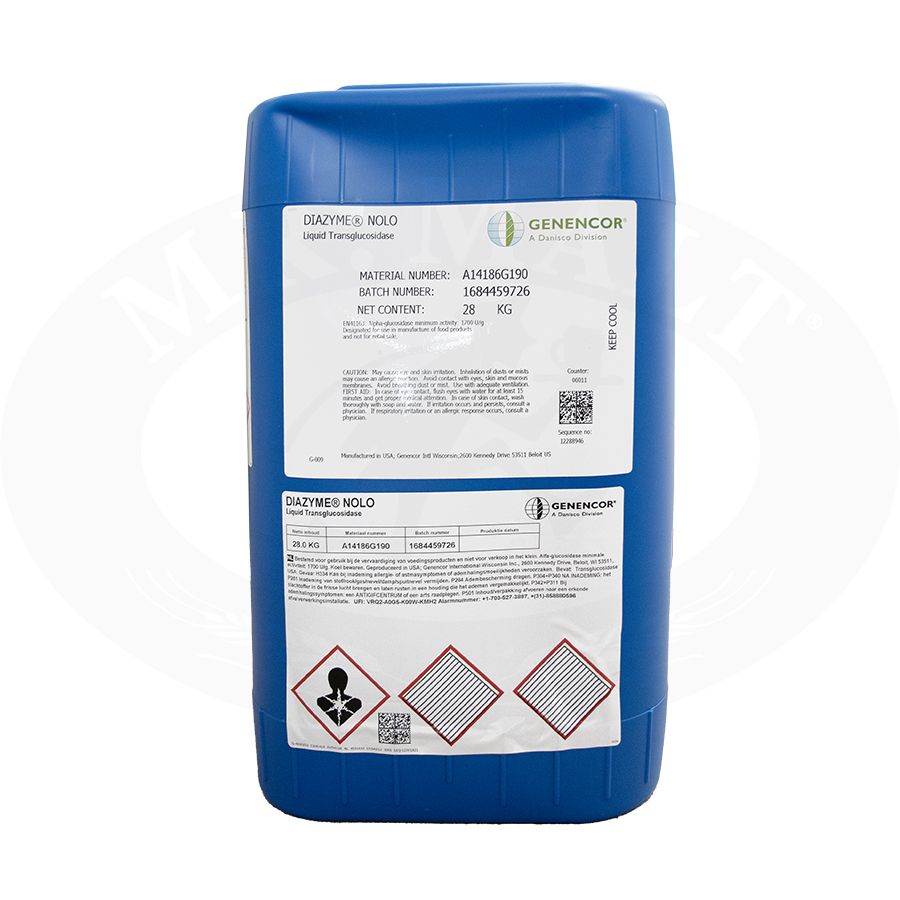


Diazyme® NOLO - 28 kg
Scadenza 07/10/2026
DIAZYME® NOLO is an innovative enzymatic solution developed by IFF to enhance the production of low- and no-alcohol (NOLO) beverages. This enzyme converts fermentable maltose into non-fermentable isomalto-oligosaccharides (IMO), thereby reducing the real degree of fermentation (RDF). Since yeast cannot ferment IMO, they do not contribute to alcohol production but improve the body and mouthfeel of the beer, offering a richer flavor profile more similar to traditional beers.
An additional advantage of DIAZYME® NOLO is its ability to easily integrate into existing brewing processes without requiring significant investments in new equipment. This allows breweries to increase production efficiency and save up to 37% on raw material usage, contributing to more sustainable production.
Furthermore, using this enzyme can lower energy consumption during the dealcoholization process, as it reduces the amount of alcohol that needs to be removed. This results in lower operational costs and a reduced environmental impact associated with NOLO beer production.
In summary, DIAZYME® NOLO provides an effective solution for brewers who want to offer low- and no-alcohol options without compromising taste and quality, while also improving production efficiency and sustainability.
Only 4 remaining
Fast shipments
According to the needs of each customer

Secure payment
Maximum protection during the purchase on all our numerous payment methods

+10000 reviews on Trustpilot
For over 30 years, thousands of customers have trusted us with the purchase of ingredients and equipment
| Cod. | 3357000 |
|---|---|
| Ingredients | Enzymatic preparation based on fungal-origin transglucosidase. |
| Use and storage | Store at temperatures below 10°C, away from direct light. Keep in the original container, tightly closed when not in use. Refer to the technical data sheet for usage instructions. |
| Weight in kg. | 28 |
| Recommended quantity | 1-5 kg/MT (1-5 g/kg of malt) - (20-100 g/hL assuming an average of 20 kg of grist per hL) |
| Usage | For the production of no- and low-alcohol beers with reduced Real Degree of Fermentation (%RDF), it is recommended to add DIAZYME® NOLO directly into the mash vessel either simultaneously with the grist or shortly after the ‘mashing-in' process. |
| Best before | Oct 7, 2026 |
| Info | The enzyme has been produced through fermentation of a microorganism that is not present in the final product. The microorganism has been optimized using modern biotechnology. The enzyme cannot be used in organic production. |
Product Questions
- DOWNLOAD PDF (Info_335_DIAZYME_NOLO_2_EN.pdf)
- DOWNLOAD PDF (FAQ_335_DIAZYME_NOLO_ENG.pdf)
Fast shipments
According to the needs of each customer
Secure payment
Maximum protection during the purchase on all our numerous payment methods
+10000 reviews on Trustpilot
For over 30 years, thousands of customers have trusted us with the purchase of ingredients and equipment